Showing posts with label Celebrations. Show all posts
Showing posts with label Celebrations. Show all posts
Friday, 25 March 2016


Sunday, 20 March 2016

Tuesday, 9 February 2016
The perfect pancakes on Shrove Tuesday


On Shrove Tuesday, people are tucking into a pancake feast, as part of a tradition that has lasted for centuries.
Traditionally, Christians would eat pancakes on the last day before Lent begins, to use up foods like eggs and milk, before starting 40 days of fasting for lent.
Now, Pancake Day is celebrated by people all over the world, and some people even hold pancake-flipping competitions.
If you want to join in, you could try this basic pancake recipe, adapted from celeb chef Delia Smith, to make enough mixture for 12-14 pancakes. Yum!
But don't forget to ask your mum and dad to help!
For the pancake mixture:
- 110g/4oz plain flour
- pinch of salt
- 2 eggs
- 200ml/7fl oz milk mixed with 75ml/3fl oz water
- 50g/2oz butter
To serve:
- caster sugar
- lemon juice
- lemon wedges
- (NR TIP: you can try anything you like - be imaginative! You could try fruit and maple syrup, chocolate spread, ice cream, melted chocolate... yum)
Instructions
Sift the flour and salt into a large mixing bowl.
Make a well in the centre of the flour and break the eggs into it.
Begin whisking the eggs.
Gradually add small quantities of the milk and water mixture, still whisking.
Whisk until all the liquid has been added and the batter has the consistency of thin cream.
Melt the butter in a pan.
Spoon 2 tbsp of it into the batter and whisk it in. Use the rest of the butter to grease the frying pan before you make each pancake.
Get the pan really hot, then turn the heat down to medium - be really careful doing this bit. You might want to get your mum and dad to help at this point!
Ladle 2 tbsp of the batter into the hot pan all in one go.
Tip it around from side to side to get the base evenly coated with batter.
After about half a minute, and when the bottom is golden in colour, flip the pancake over.
The other side will only need a few seconds to cook.
Slide the pancake out of the pan onto a plate.
To serve, sprinkle each pancake with freshly squeezed lemon juice and caster sugar.
Enjoy!
Thursday, 4 February 2016
Chinese Lunar New Year: Spectacular light show in China
A spectacular light show is taking place in China.
This year, Chinese New Year - The Year of the Monkey - begins on Monday February 8 and lasts until Jan 27th, 2017.
The new year, also known as the Spring Festival, is marked by the lunisolar Chinese calendar, so the date changes from year to year.
The festivities usually start the day before the New Year and continue until the Lantern Festival, the 15th day of the new year.
The Chinese symbol for monkey

Each Chinese New Year is characterised by one of 12 animals which appear in the Chinese zodiac. The Chinese zodiac is divided into 12 blocks (or houses) just like its western counterpart, but with the major difference being that each house has a time-length of one year instead of one month.
This year it's the Year of the Monkey, the ninth animal in the cycle. The next Year of the Monkey will be in 2028.
People born in the Year of the Monkey are characterised as quick-witted, curious, innovative and mischievous, but it is also believed to be one of the most unlucky years in the Chinese calendar.
The general image of people in this zodiac sign is of always being smart, clever and intelligent, especially in their career and wealth.
They are lively, flexible, quick-witted and versatile. In addition, their gentleness and honesty bring them an everlasting love life. Although they were born with enviable skills, they still have several shortcomings, such as an impetuous temper and a tendency to look down upon others.
Julius Caesar, Leonardo da Vinci, Charles Dickens, Lord Byron, Celine Dion, Tom Hanks, Will Smith, Halle Berry, Christina Aguilera, Diana Ross, Elizabeth Taylor, Alice Walker, Michael Douglas, Owen Wilson, Daniel Craig, Mick Jagger, Bette Davis, Annie Oakley, Eleanor Roosevelt, Cuba Gooding Jr., Gisele Bundchen, Kim Cattrall, Nick Carter, Patricia Arquette, Alyson Stoner, Christina Ricci, Demi Lovato, Miley Cyrus, Nick Jonas, Selena Gomez.
Which Chinese Zodiac sign are you?
Your sign is derived from the year you were born in the Chinese lunar calendar.
The years below are a rough guide, but if you were born in January or February it may be slightly different as the new year moves between 21 January and February 20.

In The Telegraph
Tuesday, 3 November 2015
What is Bonfire Night? The history of November 5
Why do they have Bonfire Night and fireworks displays every November 5 in the UK?

What is Bonfire Night?
On November 5 people across the UK celebrate Bonfire Night.
There are small fireworks parties in back gardens along with big organised displays in public parks.
The reason they do it is because it's the anniversary of an attempt to blow up the Houses of Parliament led by a man called Guy Fawkes.
It's called the Gunpowder Plot, and bonfires are lit to burn the "Guy" - a kind of dummy that represents Fawkes.
 Guy Fawkes (second from right) and the conspirators of the Gunpowder Plot
What was the Gunpowder Plot?
Guy (Guido) Fawkes led the Gunpowder plot in 1605. It was a plan to blow up King James I and his government.
Fawkes and his group put 36 barrels of gunpowder in cellars under the Houses of Parliament in London, ready to set off a massive explosion.
One member of the group sent a letter to his friend who worked in Parliament, warning him to stay away on November 5.

The King's supporters got hold of the letter and the plot was rumbled!
Guards broke into the cellars where the gunpowder plotters were waiting. They were arrested, tortured and executed.
The Gunpowder Plot was about religion. England was a Protestant country, and the plotters were Catholic.
The group wanted to return England to the Catholic faith. They thought they could do this by killing King James I and his ministers.
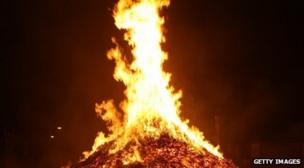
Bonfires are lit all over the UK every November 5
Monday, 2 November 2015
Pugs dress-up in costume for Halloween
Check out this special Halloween costume parade with a difference, it's just for pug-dogs.
Cute aren't they?
The parade was held in Ukraine, where about a hundred pugs showed off their finest costumes.
The devilish-doggies dressed up as spiders, angels, dragons and Halloween themed film characters.
It's simply pug-tastic! (CBBC Newsround)
Friday, 30 October 2015
The history of Halloween - how it all started
Halloween began as the festival of Samhain. It was part of the ancient Celtic religion in Britain and other parts of Europe.
At the end of summer, the Celts thought the barrier between our world and the world of ghosts and spirits got really thin.
This meant weird creatures with strange powers could wander about on Earth.
The Celts had a big party. It was all about scaring away the ghosts and spirits.
Later, with the Christian religion, the day became known as All Hallows' Eve - the day before All Saints' Day on 1 November.
America picks up the pace
It's in America that Halloween has really taken off.
Irish immigrants to the United States raised the popularity of Halloween during the 19th century.
During the 20th century it became more and more popular, with traditions like pumpkin carving and trick or treating becoming part of TV shows, books and movies. (CBBC Newsround)
Saturday, 11 July 2015
Princess Charlotte: Norfolk church creates knitted christening
Knitters have recreated Princess Charlotte's christening in wool as part of a church fundraising festival.
The replica royal event is at St Peter and St Paul's church in Norfolk - one of six churches taking part in a Blossom and Yarn Festival.
Over 11,000 squares were used to create themed scenes for the six churches.

The christening scene has been recreated in wool at the church in Griston

Woolen Prince George even has a knitted teddy bear.

The Bishop of Norwich said he was full of admiration because he "couldn't knit a bishop".
Prince Harry - who was unable to attend the event at Church of St Mary Magdalene at the Queen's Sandringham estate last Sunday - is in attendance at the knitted version.
Most of the figures and many other items, including roses, small animals and cakes, were made from 10cm knitted squares.
More than 31 human figures were created by more than 100 knitters.
From CBNBC Newsround
Monday, 1 June 2015

Sunday, 31 May 2015
The Battle of Waterloo recreated with Lego
One of the most famous battles in history has been recreated using Lego.
It's taken 20 people and more than a million bricks to construct.
It's all to mark the 200th anniversary of the Battle of Waterloo - when the famous French general Napoleon took on an army led by England.
The bicentenary of the death of Napoleon is being celebrated in the Belgian town of Waterloo with an exhibition involving over a million bricks.
Sunday, 5 April 2015

Sunday, 8 March 2015
Happy International Women's Day!
Women are the engine of Humanity
They MUST be protected, loved and respected!

They MUST be protected, loved and respected!
Saturday, 14 February 2015

Wednesday, 31 December 2014

Tuesday, 23 December 2014
Merry Christmas,kids!
Thank you all for visiting this blog and leaving your kind comments!
Thank you and MERRY XTMAS!

Saturday, 20 December 2014
Wednesday, 26 November 2014
Giant Christmas tree lights up Dortmund in Germany
 Check out this enormous Christmas tree in the city of Dortmund, Germany.
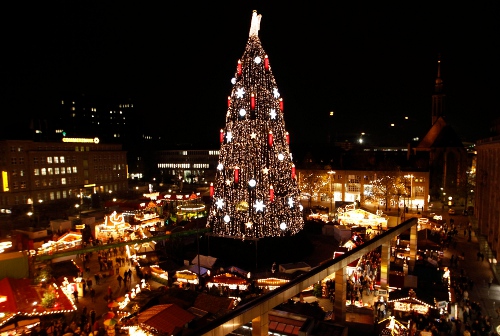
The giant tree is 100 metres tall and is actually made of 1,700 smaller trees put together.
The branches are decorated by 48,000 lights!
The organisers of Dortmund's Christmas market say the tree is the largest "real" Christmas tree in the world.
From CBBC Newsround
Sunday, 10 August 2014
Boring town celebrates pairing with Dull village
The American town of Boring in Oregon is paired with the village of Dull in Perthshire, Scotland.
To celebrate, the mayor of Oregon has officially declared 9 August as Boring and Dull Day.
The town is named after its founder, William H Boring, who began farming in the area in the 1870s.
Last Saturday's party included ice cream, Scottish bagpipes and traditional American folk singing.
From CBBC newsround
In an attempt to live up to its motto of being “the most exciting place to live,” Boring — southeast of Portland with a population of 12,851 — is celebrating the day with an ice cream social, a performance by a local barbershop quartet, a flag salute featuring the Oregon National Guard, and even a bagpiper and drummer to honor the residents of Dull, which had a population of 84 in October 2012. A sign in Dull commemorates the “twinning” of the two towns, “Welcome to Dull, Paired with Boring, Oregon, USA: Drive Safely.”
The Boring Community Planning Organization has also been selling commemorative “Boring & Dull” t-shirts and mugs, raffling off a trip to Dull, Scotland, and trying to get residents revved with promotional videos like the one above, in which one Boring resident says, “Come visit us! You’d like it. We’re not boring.”
The whole idea for this type of “sister city” partnership came about after a Scottish cyclist rode through Boring on a biking trip. Word of the rural town’s existence got back to Dull, prompting talks between legislators in the two similarly named areas.
After the holiday, the two towns can keep in touch via the Dull & Boring Facebook page, where Boring residents ask their kilt-wearing brethren questions about life in Dull like “Can I drive on the wrong side of the road?!?!” It also boasts photos of particularly bored-looking “coos” or “Highland cattle” and even a news article about the residents of the Australian region Bland who want to join forces with the two towns to make a “Boring threesome.”
From TIME http://newsfeed.time.com/2013/08/09/happy-boring-and-dull-day/
Monday, 19 May 2014
The 40 years of the Rubik's Cube

Rubik's Cube is a 3-D combination puzzle invented in 1974 by Hungarian sculptor and professor of architecture Ernő Rubik. Originally called the Magic Cube,the puzzle was licensed by Rubik to be sold by Ideal Toy Corp. in 1980 via German businessman Tibor Laczi and Seven Towns founder Tom Kremer, and won the German Game of the Year special award for Best Puzzle that year. As of January 2009, 350 million cubes had been sold worldwide making it the world's top-selling puzzle game. It is widely considered to be the world's best-selling toy.

In a classic Rubik's Cube, each of the six faces is covered by nine stickers, each of one of six solid colours: white, red, blue, orange, green, and yellow. In currently sold models, white is opposite yellow, blue is opposite green, and orange is opposite red, and the red, white and blue are arranged in that order in a clockwise arrangement. On early cubes, the position of the colours varied from cube to cube. An internal pivot mechanism enables each face to turn independently, thus mixing up the colours. For the puzzle to be solved, each face must be returned to consisting of one colour. Similar puzzles have now been produced with various numbers of sides, dimensions, and stickers, not all of them by Rubik.

Although the Rubik's Cube reached its height of mainstream popularity in the 1980s, it is still widely known and used. Many speedcubers continue to practice it and other twisty puzzles and compete for the fastest times in various categories. Since 2003, The World Cube Association, the Rubik's Cube's international governing body, has organized competitions and kept the official world records.
There is only 1 correct answer and 43 quintillion wrong ones for Rubik's Cube. God's algorithm is the answer that solves the puzzle in the least number of moves. One eighth of the world's population has laid hands on 'The Cube', the most popular puzzle in history and the colorful brainchild of Erno Rubik.
From Wikipedia
Wednesday, 30 April 2014
Army sniffer dog Sasha given top military award
An army sniffer dog who died six years ago in Afghanistan is to be awarded the highest military award for animals.

L/Cpl Rowe and Sasha his sniffer dog
Sasha, a yellow Labrador, was trained to hunt out explosives and make sure areas were safe for fellow soldiers.
She died with partner Lance Corporal Ken Rowe in a Taliban attack in 2008.
The animal charity the PDSA, which gives the award, says the Dickin Medal is the animal equivalent of the Victoria Cross - the highest military honour a person can receive.
Col Neil Smith QHVS, who is in charge of the Army's animal unit, said: "Sadly, this award is posthumous as both Sasha and her handler, Lance Corporal Ken Rowe, were killed in enemy action in Afghanistan in 2008.

Sasha will be the 65th animal to receive the PDSA medal
The PDSA says that Sasha's skill helped save the lives of many soldiers and civilians.
From CBBC newsround
Subscribe to:
Posts
(
Atom
)