Showing posts with label History. Show all posts

Saturday, 5 March 2016

New Zealanders voting on whether to change flag

People in New Zealand have started voting on whether to change their national flag.

New Zealand flags
The country's prime minister wants to change to a design so that it looks different to the UK flag.
The current flag includes the Union flag - the United Kingdom's national flag, from a time when the country was controlled by the UK.
Voters are being asked to choose between the current design and a new flag based around the traditional New Zealand silver fern.
People have three weeks to vote. ( CBBC Newsround)
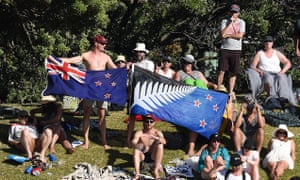
The proposed alternative New Zealand flag (right) is seen alongside the current flag during the cricket Tes between Australia and New Zealand in Wellington in February.
The proposed alternative New Zealand flag (right) is seen alongside the current flag during the cricket Tes between Australia and New Zealand in Wellington in February. Photograph: Dave Hunt/AAP

The final stage in New Zealand’s bid to change its flag has begun, with voters asked to choose between the current design and a silver fern against blue and black.
Silver Fern (Black, White and Blue), by Melbourne-based New Zealander Kyle Lockwood, was the highest-ranked of five designs in a referendum last year, with 50.58% of the vote.
The second referendum asks voters to choose between it and the current flag. Those correctly enrolled will receive papers in the mail between Thursday 3 March and Friday 11 March.
Voting in the referendum closes on Thursday 24 March with the preliminary result expected around 8.30pm local time. All votes postmarked by Wednesday 23 March will be eligible for the count. .


The final result will be declared on 30 March, after all votes received in time have been processed. If the vote is for change, there could be a transition period of around 12 months.


The referendum opens amid apparent flagging support for change, with the One News Colmar Brunton poll in late February finding that two-thirds of New Zealanders are in favour of keeping the current design.
“You can say a lot of bad things about the alternative flag, but probably the worst is that it makes the current flag look good,” wrote commentator Finlay Macdonald.
From The Guardian

Tuesday, 3 November 2015

What is Bonfire Night? The history of November 5

Why do they have Bonfire Night and fireworks displays every November 5 in the UK? 


Fireworks display

What is Bonfire Night?

On November 5 people across the UK celebrate Bonfire Night.
There are small fireworks parties in back gardens along with big organised displays in public parks.
The reason they do it is because it's the anniversary of an attempt to blow up the Houses of Parliament led by a man called Guy Fawkes.
It's called the Gunpowder Plot, and bonfires are lit to burn the "Guy" - a kind of dummy that represents Fawkes.

Image captionGuy Fawkes and conspirators of the Gunpowder PlotGuy Fawkes (second from right) and the conspirators of the Gunpowder Plot

What was the Gunpowder Plot?

Guy (Guido) Fawkes led the Gunpowder plot in 1605. It was a plan to blow up King James I and his government. 
Fawkes and his group put 36 barrels of gunpowder in cellars under the Houses of Parliament in London, ready to set off a massive explosion.
One member of the group sent a letter to his friend who worked in Parliament, warning him to stay away on November 5.


Fireworks display
Image captionThe plot was to blow up the Houses of Parliament in London

The King's supporters got hold of the letter and the plot was rumbled!
Guards broke into the cellars where the gunpowder plotters were waiting. They were arrested, tortured and executed.
The Gunpowder Plot was about religion. England was a Protestant country, and the plotters were Catholic.
The group wanted to return England to the Catholic faith. They thought they could do this by killing King James I and his ministers.
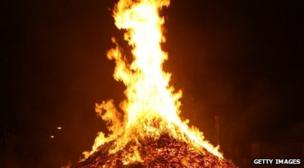
Bonfire
  Bonfires are lit all over the UK every November 5

From CBBC Newsround

Tuesday, 8 September 2015

'Biggest' Stonehenge site discovered

Archaeologists have found around 100 huge standing stones buried near Stonehenge.


Experts think the discovery could be the 'biggest' prehistoric monument ever built in Britain.
The stones were uncovered using special equipment that scans below the Earth's surface.
Researchers said finding the stones was "fantastically lucky".
Radar scanning at Durrington Walls, Wiltshire
Special radars were used to find the large stones at Durrington Walls

What is Stonehenge?

  • It's a circle of massive stones, on Salisbury Plain in Wiltshire, in the south west of England.
  • No-one knows exactly why it was built but there is a link to the sun's movements during the year and there are burial sites nearby.
  • It's thought to have been built in prehistoric times, with the stones being put up about 2,500 BC.
  • People go to the site at certain times of year, during the summer and winter solstices, when the sun lines up with gaps in the stones.
Large stones at Durrington Walls
The stones could have measured up to 4.5m in height
The latest discovery was made about 1.8 miles (3km) from Stonehenge, on the edge of the Durrington Walls "henge", or bank.
It's an area which had not yet been studied by researchers and it's thought the stones may have originally measured up to 4.5m (14ft) in height.
Lead researcher, Vince Gaffney said the stones were "lost to archaeology" but found thanks to modern technology.

Large stones at Durrington Walls
The row of stones were standing over the edge of the bank of the henge
The findings are being announced later on the first day of the British Science Festival being held at the University of Bradford.

From CBBC Newsround

Wednesday, 5 August 2015

Hiroshima - A Survivor's Story

On the 70th anniversary of the atomic bombing of the city of Hiroshima, on the 6th August in 1945.


What happened in Hiroshima?
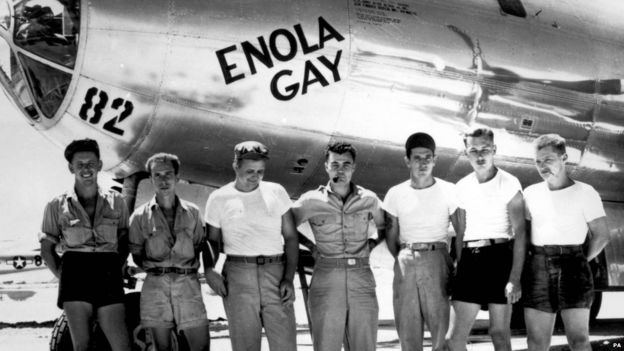
The ground crew of the B-29 'Enola Gay' which atom-bombed Hiroshima, Japan. Col. Paul W. Tibbets, the pilot is the centre.On 6 August 1945, at 8.15am Japanese time, an American B-29 bomber plane, called 'Enola Gay', dropped an atomic bomb on the Japanese city of Hiroshima.
The devastation was beyond anything seen before. The city was immediately flattened.
80,000 people were killed as a direct result of the blast, and another 35,000 were injured.

The plume of smoke from a mushroom cloud billow, about one hour after the nuclear bomb was detonated above Hiroshima, Japan

A huge mushroom cloud of smoke fills the sky over Hiroshima, Japan, one hour after it was bombed in August 1945

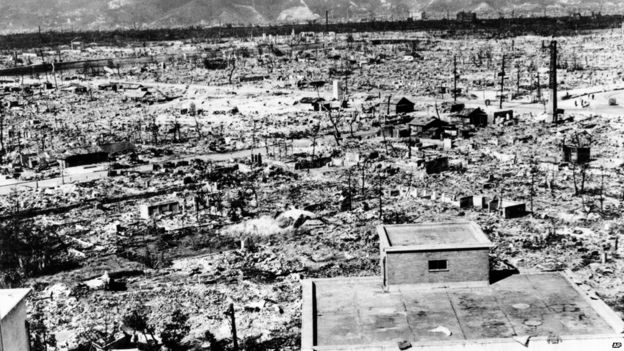
In this undated picture provided by the U.S. Strategic Bombing Survey, the destroyed city of Hiroshima, Japan is seen from the Red Cross hospital building located about one mile from the epicenter of the nuclear blast from the 'Little Boy' atomic bomb which was detonated by the U.S

Even then, Japan didn't surrender.
Three days later, another nuclear bomb was dropped by the Americans on the Japanese city of Nagasaki.
Shortly afterwards, on 15 August 1945, Japan finally admitted defeat.
World War Two was over.
There were celebrations in Europe after Germany surrendered.
But on the other side of the world in the Pacific Ocean, Japan was still fighting against America, Britain and their allies.
The Americans, however, had a secret plan to end the war - by using the most powerful weapon ever created

What damage did the bombs cause?

This building, now called the A Bomb Dome, survived the atomic blast and today it's a memorial
This building, now called the A Bomb Dome, survived the atomic blast and today it's a memorial in Hiroshima, Japan

When the bomb exploded in Hiroshima, the city has struck by a flash of blinding light then a giant cloud shaped like a mushroom.
The blast flattened buildings within a 2.5 km radius of the bomb.
There were 90,000 buildings in Hiroshima before the bomb was dropped but only 28,000 remained after the explosion.

Thousands and thousands of people were killed. Many were badly injured.
But the suffering didn't end there because it wasn't just a normal bomb.
The nuclear radiation released when it exploded caused people to suffer horrible illnesses.
Thousands more people died from their injuries and radiation sickness in the weeks, months and years that followed.

Why did the US drop the bomb?


The Hiroshima bomb was nicknamed 'Little Boy'. Here it is before being loaded into the Enola Gay's bomb bay

Japan had been at war for many years.
It had invaded the countries near to it such as China and the Japanese had attacked America.
Everywhere the Japanese soldiers went, they were known for their cruelty.
They treated prisoners of war very badly, including American and British soldiers who had surrendered. (CBBC Newsround)

Tuesday, 9 June 2015

Theropod-the first meat-eating dinosaur goes on show in Wales

This is an artist's impression of a meat-eating Jurassic dinosaur that was found on a south Wales beach in 2014.


Artist's reconstruction of the dinosaur based on fossils found in south Wales
The fossilised skeleton is only now being revealed to the public for the first time.It's a small theropod dinosaur.That's a distant cousin of the giant Tyrannosaurus Rex.It would have stood at about 50 cm high and about 2 metres long.
Nick and Rob Hanigan working at Lavernock beach
Nick and Rob Hanigan uncover the fossilised remains inch by inch
Fossil-hunting brothers Nick and Rob Hanigan found it at Lavernock, Vale of Glamorgan. There had been a cliff rock fall.
They have now donated it to the National Museum Wales.
Experts there believe the fossilised remains date back more than 200 million years to the very earliest part of the Jurassic Period.
The theropod is the first meat-eating dinosaur fossil to be found in Wales.
It's also one of the oldest finds from the Jurassic Period in the world.
The fossils show it had lots of small blade-like teeth. That suggests it lived on insects, small mammals and other reptiles.
Claw fossil
One of the Dinosaur's fossilised claws
The brothers spent last year carefully preparing five stone blocks to uncover the full fossil, before getting in touch with museum experts.
"This is a once-in-a-lifetime find," said Nick Hanigan. "Preparing the skull to seeing the teeth of a theropod for the first time in 200 million years was fantastic - you just can't beat that sort of thing."
Hand and claw bones
'Hand' and claw bones
is brother Rob said, "It has always been our intention to donate our dinosaur to the museum for the public and scientists to see and research."
The hip and vertebrae of the Welsh dinosaur called a ''theropod''
-Theropod dinosaur Fact file-
  • Location: Fossilised skeleton found on a beach near Penarth in the Vale of Glamorgan
  • Family: Distant cousin of Tyranossaurus rex
  • Era: earliest part of the Jurassic Period 201 million years ago, possibly making it the oldest dinosaur in the world
  • Diet: First ever meat eating dinosaur 
From CBBC News

Wednesday, 8 October 2014

Eiffel Tower gets glass floor in refurbishment project

A vertigo-inducing glass floor has been installed at the Eiffel Tower, France's most visited tourist attraction


For those scared of heights, the Eiffel Tower's new floor may be something of a challenge.
Visitors will be able to look down on Paris through a glass floor as part of a refurbishment of the tower.


Visitors to the Eiffel Tower in Paris will now be able to look down through a vertigo-inducing glass floor that forms part of a €30 million (£24m) refit of France’s most visited tourist attraction.
The transparent floor will be on the first level of the tower, at 57m, where operators hope that visitors will linger before heading to the highest viewing platform at 276 metres above the ground. Traditionally, tourists to the Eiffel Tower spend little time here before moving on to catch the better views from the two higher levels.
“We wanted people to realise how the building is anchored with its four pillars in the ground”, Alain Moatti, the architect in charge of the renovation, told le Journal du Dimanche, the French Sunday newspaper.
The refit of the half-hectare first floor, which began in May 2012 and was unveiled to the public today, also includes shops, restaurants and a museum telling the story of the 125-year-old construction. The tower’s eco-friendliness has also improved, with the installation of four solar panels that will provide about half of the tower’s hot water requirements. Some of the toilets will also be operated using rain water.
                                    A tourist captures the view (Photo: Reuters)
About seven million people visit the Eiffel Tower each year – 85 per cent of them foreigners – making it the world’s busiest paid-for tourist attraction. The tower’s management also hopes that the renovation will attract more Parisians to the “Dame en Fer” (The Iron Lady), as it is sometimes referred to in French.
The tower opened in 1889 and was named after Gustave Eiffel, whose company engineered the project. At 324m in height, it was the world’s tallest building for 41 years until the Chrysler building was built in New York in 1930.
From CBBC newsround and The Telegraph

Wednesday, 6 August 2014

Boys unearth gold hair tress from 2,300 BC

A group of schoolboys has unearthed a rare 4,000-year-old ornament during a dig in Northumberland.

Gold ornament
It is hoped the hair tress will be reunited with one found in 1935

The children from Cumbria were taking part in an excavation at Kirkhaugh when they saw a glint of gold in the soil.
The object, which was found in a burial mound, is believed to be a decorated hair tress from about 2,300 BC.
One of the boys, 7 year-old Joseph, said when he saw the gold in the ground he started "dancing with joy".

Rare discovery

The ornament, which is 33mm long and dates back to the Copper Age, was found alongside three flint arrowheads and a jet button.
Boys
The boys said they were "very happy" when they found out their find was gold
It is thought to have been worn by a metal worker who could have travelled to Britain from overseas in search of gold and copper.
The dig was arranged by the North Pennines Area of Outstanding Natural Beauty as part of an archaeology project.
From CBBC newsround

Friday, 27 June 2014

Caveman poo suggests they may have eaten vegetables

Scientists studying Neanderthal poo say that our prehistoric ancestors ate far more vegetables than had been thought.


Who were the Neanderthals?

  • Their ancestors left Africa 400,000 years ago
  • They travelled to Europe and Asia where they evolved into Neanderthals
  • They went extinct 30,000 years ago
Actors portraying Neanderthals from Andrew Marr's History of the World
Researchers examined ancient specimens of poo, from people who lived in part of southern Spain 50,000 years ago.
They found that while all the samples contained traces of meat, but two showed signs of plant matter, suggesting they ate their veg too.
The study's authors say the results will help us understand how humans have come to dominate the planet.
By doing detailed tests on the ancient poo, the team found that while meat was the main part of Neanderthals' diet, they may have also consumed a fairly regular portion of plants, such as tubers, berries, and nuts.
"We believe Neanderthals probably ate what was available in different situations, seasons, and climates," says Ainara Sistiaga, from the University of La Laguna in Spain, who worked on the study with colleagues from MIT in America.
Traces in the teeth
This latest finding comes after the recent discovery of plant microfossils trapped in Neanderthal teeth - which some thought might suggest fruit and veg in their diet.
But Ainara's more cautious about the teeth evidence: "Sometimes in prehistoric societies, they used their teeth as tools, biting plants, among other things.
Neanderthal artist's impression
"We can't assume they were actually eating the plants based on finding microfossils in their teeth."
The traces this study found in the poo, suggest the first direct evidence for a more varied diet for our cavemen ancestors.


The results of the study were published in the journal PLoS One.
From CBBC newsround