Showing posts with label Food. Show all posts

Tuesday, 9 February 2016

The perfect pancakes on Shrove Tuesday

On Shrove Tuesday, people are tucking into a pancake feast, as part of a tradition that has lasted for centuries.


Traditionally, Christians would eat pancakes on the last day before Lent begins, to use up foods like eggs and milk, before starting 40 days of fasting for lent.
Now, Pancake Day is celebrated by people all over the world, and some people even hold pancake-flipping competitions.
If you want to join in, you could try this basic pancake recipe, adapted from celeb chef Delia Smith, to make enough mixture for 12-14 pancakes. Yum!
But don't forget to ask your mum and dad to help!

For the pancake mixture:

  • 110g/4oz plain flour
  • pinch of salt
  • 2 eggs
  • 200ml/7fl oz milk mixed with 75ml/3fl oz water
  • 50g/2oz butter

To serve:

  • caster sugar
  • lemon juice
  • lemon wedges
  • (NR TIP: you can try anything you like - be imaginative! You could try fruit and maple syrup, chocolate spread, ice cream, melted chocolate... yum)

Instructions

Sift the flour and salt into a large mixing bowl.
Make a well in the centre of the flour and break the eggs into it.
Begin whisking the eggs.
Gradually add small quantities of the milk and water mixture, still whisking.
Whisk until all the liquid has been added and the batter has the consistency of thin cream.
Melt the butter in a pan.
Spoon 2 tbsp of it into the batter and whisk it in. Use the rest of the butter to grease the frying pan before you make each pancake.
Get the pan really hot, then turn the heat down to medium - be really careful doing this bit. You might want to get your mum and dad to help at this point!
Ladle 2 tbsp of the batter into the hot pan all in one go.
Tip it around from side to side to get the base evenly coated with batter.
After about half a minute, and when the bottom is golden in colour, flip the pancake over.
The other side will only need a few seconds to cook.
Slide the pancake out of the pan onto a plate.
To serve, sprinkle each pancake with freshly squeezed lemon juice and caster sugar.
Enjoy!


Wednesday, 27 May 2015

Fish and chips the play makes its stage debut

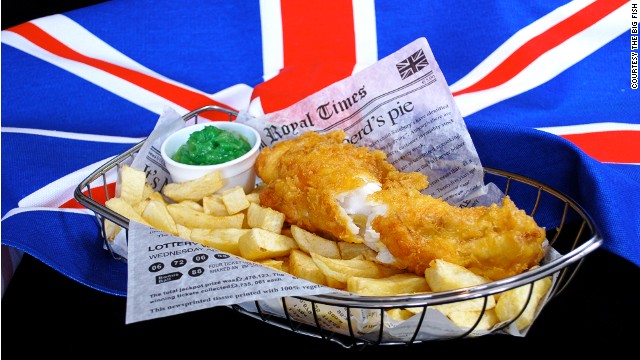
Britain's love of fish and chips is so great that a play has been written about it.
One of Each is a tale of storms at sea, saucy secrets and sibling rivalry centred around two fish and chip shops who are battling to win the coveted title of "Golden Fish Fork". (BBC News)

Fish and chips is a hot dish of English origin, consisting of battered fish, commonly Atlantic cod or haddock, and deep-fried chips. It is a common take-away food.
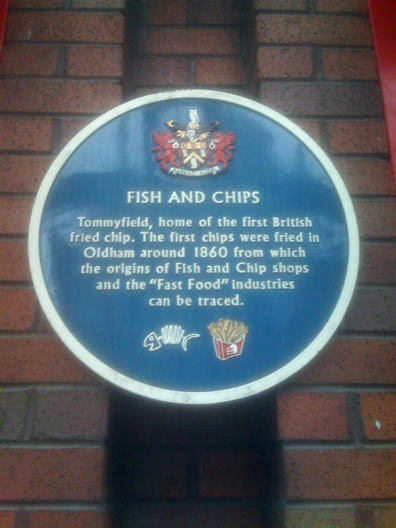
Fish and chips became a stock meal among the working classes in England as a consequence of the rapid development of trawl fishing in the North Sea, and the development of railways which connected the ports to major industrial cities during the second half of the 19th century, which meant that fresh fish could be rapidly transported to the heavily populated areas. Deep-fried fish was first introduced into Britain during the 16th century by Jewish refugees from Portugal and Spain, and is derived from pescado frito. In 1860, the first fish and chip shop was opened in London by Joseph Malin.
Deep-fried chips (slices or pieces of potato) as a dish may have first appeared in Britain in about the same period: the Oxford English Dictionary notes as its earliest usage of "chips" in this sense the mention in Dickens' A Tale of Two Cities(published in 1859): "Husky chips of potatoes, fried with some reluctant drops of oil".
blue plaque marking the first chip shop in Britain, in Oldham
The modern fish-and-chip shop ("chippy" or "chipper" in modern British slang) originated in the United Kingdom, although outlets selling fried food occurred commonly throughout Europe. Early fish-and-chip shops had only very basic facilities. Usually these consisted principally of a large cauldron of cooking fat, heated by a coal fire. During World War II fish and chips remained one of the few foods in the United Kingdom not subject to rationing.
In the United Kingdom the Fish Labelling Regulations 2003 and in Ireland the European Communities (Labelling of Fishery and Aquaculture Products) Regulations 2003  respectively enact directive 2065/2001/EC, and generally mean that "fish" must be sold with the particular commercial name or species named; so "cod and chips" now appears on menus rather than the more vague "fish and chips". In the United Kingdom the Food Standards Agency guidance excludes caterers from this. but several local Trading Standards authorities and others do say it cannot be sold merely as "fish and chips". (in Wikipedia)

Wednesday, 25 March 2015

What does a healthy diet consist of?

For a healthy diet, replace unhealthy and fattening foods with healthier alternatives, such as fresh fruits and vegetables.


"It's important to keep things in moderation and balance."


Healthy Eating Tips

Starting Points

Your food and physical activity choices each day affect your health — how you feel today, tomorrow, and in the future.

These tips and ideas are a starting point. You will find a wealth of suggestions here that can help you get started toward a healthy diet. Choose a change that you can make today, and move toward a healthier you.

Saturday, 29 November 2014

Largest cake sculpture record attempt

A world record attempt for the largest cake sculpture has been launched in London.


The massive cake was put together by forty five volunteers over six hours and is big enough to feed twelve thousand people!
It weighs two tonnes, which is nearly the same weight as an average African elephant.
But to break the record the entire cake must be eaten, with all the money raised going towards a children's charity. Yum!

From CBBC newsround


Saturday, 18 October 2014

Sugary drinks warning signs change habits of US teens

Signs warning shoppers how much exercise they need to do to burn off calories in sugary drinks can encourage healthier choices, US research suggests.

Fizzy drinks contain lots of sugar
Some teenage shoppers were influenced by the signs and chose healthier drinks

A study of teenagers' purchasing habits found they bought fewer sugary drinks and more water when the signs were up.
The most effective sign said it took five miles to walk off the 250 calories in a sugary drink.
Public Health England said the study showed simple health messages worked.
Study leader Dr Sara Bleich, associate professor at the Bloomberg School, John Hopkins University, said people do not understand calorie content on its own on a label.
"What our research found is that when you explain calories in an easily understandable way such as how many miles of walking is needed to burn them off, you can encourage behaviour change."
For six weeks, the brightly coloured signs were displayed in corner shops in neighbourhoods in Baltimore, in full view of young customers buying sugary drinks.
Four different signs were used in the shops. Two translated the calories in the drinks into the amount of exercise needed to burn off those calories.
One sign said it would take 50 minutes of running to work off the 250 calories - or 16 teaspoons of sugar - contained in a 590ml bottle of fizzy drink, sports drink or fruit juice.
The remaining signs listed the sugar content of the drink and the calories contained in the drink.
Sugary drink
Sugary drinks, such as fruit juices and fizzy drinks, can contain up to nine teaspoons of sugar in one can
A can of fizzy drink, which is 330ml in size in the UK, contains around nine teaspoons of sugar.
To find out the impact of the signs, the researchers - writing in the American Journal of Public Health - interviewed children aged between 12 and 18 years old leaving the shop.
Out of the 35% of those interviewed who said they saw the signs, 59% said they believed the sign and 40% said their behaviour had changed as a consequence.
Before the signs were put up, 98% of drinks bought in the shops were sugary ones. After six weeks, this was reduced to 89%.
During the time the signs were on view, sales of larger bottles of fizzy drinks went down from 54% to 37% of all purchases.
The percentage of teenagers who chose to buy no drink at all in the shops increased from 27% to 33%.
This change in behaviour continued for several weeks after the "exercise" signs were taken down, the study adds.
In total, more than 3,000 drinks purchases were observed by the research team.
Dr Bleich said the findings could help in the fight against obesity,

Saturday, 2 August 2014

The Most Expensive Food In The World: 10 Lavish Alternatives To Your Everyday Dishes

Look at these foods! What do you think of this?My opinion is that this is a kind of outrageous provokation to those who have nothing to eat but rice or to those who starve to death in places where even common  food is something they have never seen!

expensive food dishes

Tuesday, 4 March 2014

Enjoy your Shrove Tuesday!


Shrove Tuesday (also known as Shrovetide Tuesday, Pancake Tuesday and Pancake Day) is the day preceding Ash Wednesday, the first day of Lent. Shrove Tuesday, a moveable feast, is determined by Easter.
The expression "Shrove Tuesday" comes from the word shrive, meaning "confess".Shrove Tuesday is observed by many Christians, including Anglicans, Lutherans, Methodists and Roman Catholics, who "make a special point of self-examination, of considering what wrongs they need to repent, and what amendments of life or areas of spiritual growth they especially need to ask God's help in dealing with." Being the last day before the penitential season of Lent, related popular practices, such as indulging in food that one sacrifices for the upcoming forty days, are associated with Shrove Tuesday celebrations, before commencing the fasting and religious obligations associated with Lent. The term Mardi Gras is French for Fat Tuesday, referring to the practice of the last night of eating richer, fatty foods before the ritual fasting of the Lenten season, which begins on Ash Wednesday.
in Wikipedia

This video will show you how to make delicious easy cheap pancakes.
Watch it now and make your pancakes right away!


Tuesday, 2 April 2013

What's in your fish and chips?

Scientists from Salford University claim large amounts of white fish in Britain is labelled incorrectly and being swapped for cheaper types of fish.

They discovered seven per cent of cod and haddock - what you find in your fish and chips - was actually the cheaper pollock, or farmed fish from Vietnam.
Dr Stefano Mariani from Salford University is concerned consumers are being deceived: "Consumers should be able to go to a shop and know they are eating what they paid for."
Even though scientists say there's no serious health risk, Dr Mariani said it could be a problem for people with certain allergies if they don't know what they're eating.
Cod
Cod is sometimes being replaced by cheaper fish without the consumer knowing.

He wants tougher regulation and better labelling and is worried that if fish aren't labelled correctly, over-fishing of certain types could be harder to trace.
Mark Drummond, from the organisation representing fish and chip shops, also wants more accurate labelling.
He says it will protect the consumer but also the restaurants who are serving their customers honestly and not trying to cut costs through deception.

From CBBC News

Sunday, 24 March 2013

Plastic found in Kit Kat bars in UK

Nestle has withdrawn thousands of chocolate bars and Easter eggs after plastic was found in some of their products.


Kit Kat


The 48 gram bars of peanut butter, chocolate fudge, caramel and hazelnut are affected.
Plastic has also been discovered in their giant Easter eggs as well.
If you've already bought one, return it to the shop, unopened, to get your money back.
Nestle has apologised to customers and urged those who have purchased the bars to not eat them and return them unopened to receive a full refund.
A spokesman for the company said: ‘The safety and quality of our products are non-negotiable priorities for the company.
‘We sincerely apologise to our consumers for any inconvenience caused by this voluntary recall.’
The affected Nestle bars include:
Kit Kat Chunky Peanut Butter (48g) with a best before date range of September 2013 to February 2014.
Kit Kat Chunky Hazelnut (48g) with a best before date range of September to October 2013.
Kit Kat Chunky Choc Fudge (48g) with a best before date range of September to October 2013.
Kit Kat Chunky Caramel (48g) with a best before date range of June to July 2013.
Kit Kat Chunky Hazelnut Multipack with a best before date range September to December 2013.
Kit Kat Chunky Collection Giant Egg with a best before date of July 2013.
From CBBC and Metro

Wednesday, 6 March 2013

Does skipping breakfast make you put on weight?

It’s a plausible theory, until you look through the evidence. Then things become a little messy.

Does skipping breakfast make you put on weight?
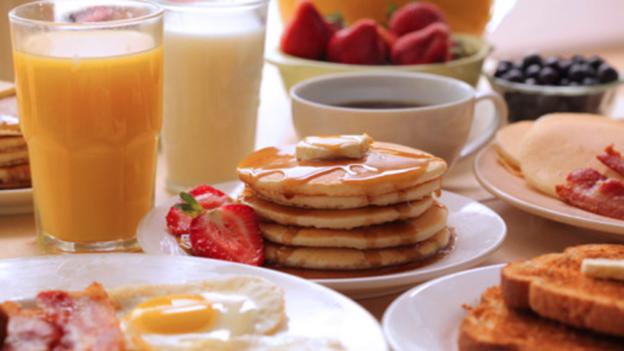
We’re often told that breakfast is an essential part of a healthy diet, especially if you are watching your weight. Some schools run breakfast to ensure that as many pupils as possible eat this all-important first meal of the day. But not everyone can stomach an early morning meal. In Europe and US between 10% and 30% of people skip breakfast, with teenage girls most likely to give it a miss, saying they’ve not got time, don’t feel hungry or that they’re on a diet.
Missing breakfast for dietary reasons runs counter to a great deal of advice. The logic goes that missing an early morning meal will leave you hungry for the rest of the day, tempting you to snack on high-calorie foods, and resulting in weight gain. 
It’s a plausible theory, until you look for evidence that people who skip breakfast consume any more calories than anyone else. The impact skipping breakfast has on weight is harder to study systematically than you might expect. The first problem is how to define that first meal of the day. How much food counts as a real breakfast? Do you have to eat it seven days a week to be defined as a breakfast-eater? And how early in the day does it need to be eaten? For example, when the US Department of Agriculture conducted a systematic review on the topic they found that most studies defined breakfast as food eaten before ten in the morning. Anyone who ate at 10.05 was considered to have skipped breakfast, which could skew the results.
Another difficulty is that what is eaten for breakfast varies from country to country. In Scandinavia it might include smoked fish, in Germany cold meats, and in the UK boxed cereals, which can often contain more sugar and salt than people realise (the Consensus Action on Salt and Health group says some cereals are saltier than seawater). This makes the impact of eating breakfast more difficult to study on a global level because the nutritional benefits will depend on what you include in the meal.
From BBC News - Health